
Our Ethical Standard
Ethics are not slogans. They are revealed through ordinary decisions: what customers are promised, how cleaners are paid, how much work is scheduled and who carries the cost when management gets something wrong.
A service business becomes unjust when one person makes the promise, another performs the work and a third is left carrying the cost.
Our purpose is to organise Claro’s so that honest work, fair treatment, customer value and the long-term interests of the business reinforce one another.
The People Who Do the Work
Cleaning is physical, skilled work performed inside other people’s homes. The people doing it should be treated as professionals, not as an invisible cost to be squeezed.
A good service business must create value for the people delivering the service as well as for the people buying it.
In practice, this means:
- Pay must be explained clearly, calculated accurately and delivered when promised. We will not use arbitrary deductions or treat unpaid duties as proof of commitment.
- Jobs must allow realistic working and travel time. Constant rushing and excessive overtime usually mean the system needs fixing, not that cleaners need to sacrifice more.
- Cleaners must understand the agreed scope before starting. If management has estimated, scheduled or communicated a job poorly, management owns that problem. It should not be solved by demanding free labour.
- People must have suitable products, equipment, protective gear, information and training for the work expected of them.
- Feedback must be specific and respectful. Mistakes should be corrected, but humiliation is not a management tool.
- Cleaners must be able to raise concerns about pay, safety, workload or treatment without fear of retaliation.
- Nobody working for Claro’s should be expected to tolerate threats, harassment, discrimination or degrading treatment. Respect is a condition of service, and we may decline or end work when that condition is broken.
Responsibility should follow cause. A failure in training, equipment, information or scheduling should not be blamed on a cleaner. Repeated negligence should not be disguised as a system problem either.
The Customers Who Trust Us
Customers invite us into their homes and pay us to perform a defined service. That trust creates serious obligations on our side.
Prices, scope and important limitations must be explained honestly. We will not hide charges or promise more than the booked service can reasonably provide.
A booking reserves professional cleaning time. It does not guarantee completion of an entire property regardless of its size or condition. A smaller booking reduces the time available; it does not reduce the amount of work the property needs.
The customer’s priorities should guide how the booked time is used. If everything cannot reasonably be completed, we should say so rather than lower the cleaning standard merely to claim that everything was done.
Homes, belongings and private information must be treated with care. Photos, videos and timelapses should only be taken with permission.
If something is damaged or we make a significant mistake, it should be disclosed rather than concealed.
Complaints should be judged on the facts. A customer should not be dismissed merely to protect the business, and a cleaner should not be blamed merely to satisfy a customer. When a failure was caused by our planning, communication or management, we should take responsibility for it.
Trust is reciprocal. Customers are expected to describe the property and its condition honestly, provide safe access, respect the agreed scope and treat cleaners professionally. A fair exchange requires accurate information and decent conduct on both sides.
These commitments to customers and cleaners are not competing interests. Someone who is properly equipped, fairly compensated, treated with respect and given realistic time is in a much better position to perform careful, dependable work.
Value for Value
We believe good business is a voluntary exchange of value for value.
A customer should receive work worth paying for.
A cleaner should receive the compensation and working conditions agreed for the skill, effort and responsibility they bring.
The business should earn its return by organising that exchange properly, keeping its promises and accepting responsibility for the result.
No party should be expected to carry costs created by someone else’s dishonesty, negligence or poor planning.
We do not apologise for earning a profit. Revenue pays cleaners and the other costs of doing the work. A profitable business can build reserves, replace equipment, improve its systems, invest in training and grow.
But profit must be earned. It should not come from hiding costs, misleading customers, underpaying cleaners or shifting management failures onto other people.
Fair profit is not the opposite of ethics. It is the reward for creating and sustaining real value.
That is the standard: voluntary trade, clear expectations and earned value.
Why the Name Claro
These principles are my responsibility. The name, however, is personal.
Claro comes from my namesake, Dr. Claro R. Ceniza. My maternal grandfather practised law before devoting himself to philosophy and teaching.
I met Lolo Claro only briefly in Dumaguete when I was very young, so I will not pretend that he personally taught me how to run a business. What I discovered later, through family accounts and his philosophical writings, was that he was quietly intelligent, had a rigorous work ethic and was generous in spirit.
My father, Jim Penman, began with a small lawn-mowing business in Melbourne and built Jim’s Group across many different local services.
The lesson I take from those histories is straightforward: a service business cannot sustainably serve customers by treating the people doing the work as expendable.
Those influences help explain the name and some of the ideas behind the business. What Claro’s does with them is my responsibility.
What the Claro Name Must Mean
There are already many capable cleaners and service providers in Dumaguete and the surrounding communities. Our contribution is not to pretend otherwise.
It is to combine personal local service with clearer systems and visible accountability.
Customers should know what they are booking, what the priorities are and who is responsible when something goes wrong.
Cleaners should know what is expected, how they will be paid and where they can turn when they need support.
Professional service does not need to feel impersonal. It should simply be organised well enough to keep its promises.
A clean home gives customers back useful time and reduces the work waiting for them at the end of the day. A well-run cleaning business gives capable people an opportunity to earn through skilled, productive work.
Both are real values.
Cleaning is Claro’s first service. If we expand into other practical services, these standards must expand with us. The Claro name should only appear on work we are prepared to organise properly and stand behind personally.
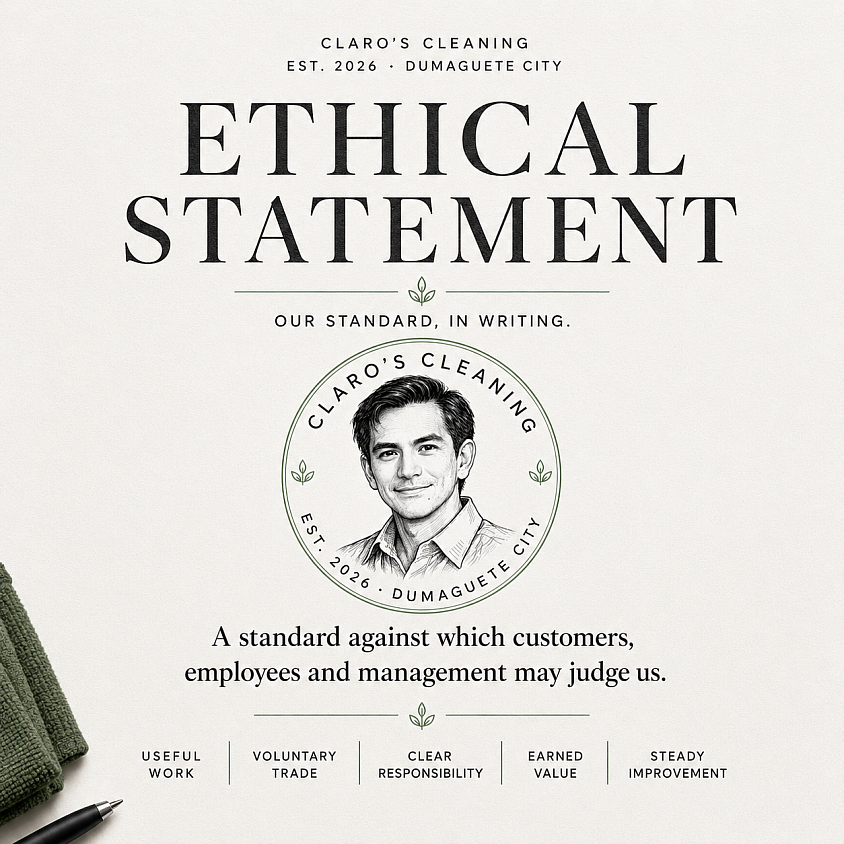
This statement is not a claim that we will never make mistakes. It is a standard against which customers, cleaners and management may judge us.
When we fall short, our responsibility is to identify whether the cause was conduct, training, equipment, information or the system itself; correct what we can; and reduce the chance of it happening again.
Useful work.
Voluntary trade.
Clear responsibility.
Earned value.
Steady improvement.
That is what Claro’s is here to build.
